

How To Repair Tie Rod
On an automobile, whether a light truck or a rider car, the steering forces are carried from the key steering gearbox or rack and pinion out to the steering arms past tie rods. An inner necktie rod and an outer tie rod are present on each side, and each of these has a ball socket; allowing free movement.
On a vehicle that uses a rack and pinion steering assembly, the outer necktie rod ends have a tapered pin that bolts into the steering arm. The body of the outer necktie rod finish is normally bandage iron and machined with internal threads that the inner tie rod screws into.
The inner tie rod threads into the outer; allowing the length of the two to be adjusted for the purpose of aligning the front wheels. On the contrary terminate of the inner tie rod on the ball-socket side, in that location is another threaded end that screws into the steering rack assembly.
Necktie Rod End Replacement Costs
The basic labor time for replacing an outer joint is almost e'er iii to 4 tenths of an hour. There is a great deal more than variety in the labor fourth dimension of replacing an inner articulation if the vehicle uses a rack and pinion for steering. For some examples of tie rod replacement price on common vehicles, using $100 an hour equally a labor charge per unit:
- On a 2007 BMW 328i, the labor time for the inner tie rod replacement is around 4.0 hours (with steering rack removal). A manufactory inner necktie rod finish costs around $209 and a Moog replacement part is about $36. The total cost to complete the job is around $609 using a manufactory part and around $436 using an aftermarket function. To replace an outer tie rod for, the labor fourth dimension is 0.four hours. A manufactory outer tie rod end costs around $125 and a Moog replacement part is around $22. The total toll to complete the job is around $165 using a factory office and around $62 using an aftermarket function.
- On a 2006 Chevrolet Silverado 1500, the labor time for an inner necktie rod replacement is effectually 0.ix hours. An ACDelco tie rod price is near $34; making the total job price about $94. To supercede an outer tie rod terminate, the labor time is around 0.6 hours and an ACDelco part is about $35. The total toll to complete the job for an outer articulation is around $95.
- On a 2010 Ford Fusion, the labor time for an inner tie rod replacement is around 3.1 hours (with steering rack removal). A factory replacement function costs effectually $37 and a Delphi replacement part is about $22; making the total cost to consummate the task around $347 using a manufacturing plant office or $332 using an aftermarket part. To replace the outer tie rod end of this vehicle model, the labor time is around 0.4 hours. A factory replacement part costs about $61 and a Delphi replacement office costs about $29. The total cost to complete the job is $101 using a manufacturing plant part and about $69 using an aftermarket part.
- On a 2006 Mazda 3, the labor time for an inner necktie rod replacement is estimated at iii.0 hours (with steering rack removal). A factory replacement part costs around $75 and a Proforged replacement role costs around $19. The total cost to complete the job is $375 using a factory office and virtually $319 using an aftermarket part. To supervene upon its outer tie rod, the labor time is approximately 0.4 hours. A factory replacement part costs around $64 and a Proforged office is around $23. The full price to complete the task is $104 using a manufactory function or around $63 using an aftermarket part.
Other Cost Considerations
In add-on to the parts costs for factory and manufactory-equivalent tie rod ends, there are "economy" replacement parts commonly available. These usually range from virtually $10 to $20. Opinions vary equally to quality. Where a good-quality front end part from a name-brand manufacturer will often carry a lifetime warranty, economic system parts ordinarily come up with a ane-twelvemonth warranty.
On summit of all those cost estimates, any time a tie rod is replaced, the vehicle will need to be aligned. The range of costs for a cycle alignment is around $50 to $150, depending on vehicle and shop.
It'south usually best to have necktie rod replacements done at a shop that is equipped to besides do the wheel alignment then that the vehicle doesn't demand to be driven without having the alignment ready.
Information technology's worth mentioning that the labor times for inner necktie rod replacement that include the removal of the steering rack that this procedure is rarely followed. It's much more mutual that the inner tie rod can be replaced without removing the steering rack using special tools that are commonly available. In many cases, a flat rate will exist applied rather than book time for the task; typically about 2 hours.
One thing that comes up oftentimes is that, if i necktie rod is worn, sometimes, a shop volition recommend replacing all the necktie rods at the aforementioned time.
In that location are some cost savings when replacing all the parts at the aforementioned time due to overlapping labor, but the main decision might be best made based on how long the vehicle is intended to be kept.
Mechanically, there is no reason to replace a part that hasn't failed. Just on a high mileage vehicle that is intended to be kept on the road and kept reliable over the long-term, it may be a reasonable selection.
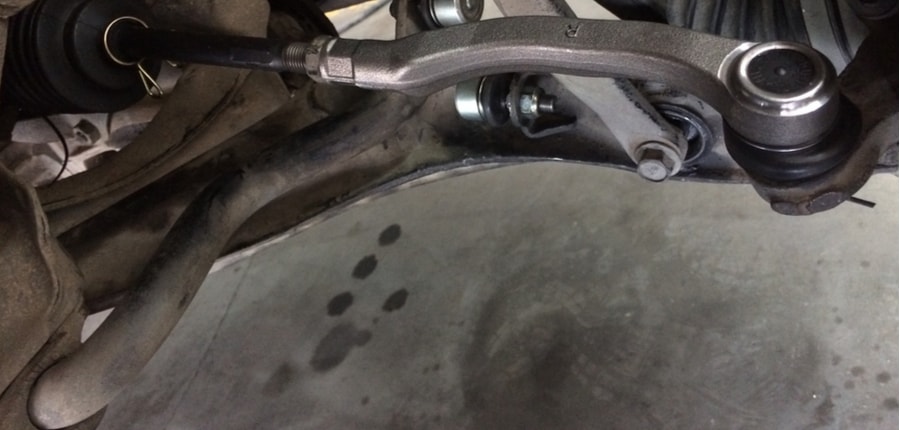
Necktie Rod End Replacement
Replacement of the outer tie rod end is very simple – a matter of breaking the tapered pin loose from the steering arm and unscrewing the role from the inner tie rod cease. Replacing the inner is often more complicated due to restricted admission and occasionally, there is a need for a special tool to plough the inner socket.
Some manufacturers require that the steering rack and pinion exist removed from the vehicle for inner tie rod stop replacement.
On a vehicle with a steering gearbox, the inner and outer tie rod ends are often nearly identical. While the outer has a tapered pin that bolts to the steering arm, the inner has a tapered pin that bolts to a centre link.
The inner and outer will ordinarily be connected by an adjusting sleeve and the replacement of either is a elementary affair of breaking the tapered articulation and unscrewing the necktie rod end from the sleeve.
On a vehicle with a solid front axle such as some 1-ton trucks, at that place are oft merely two outer necktie rod ends (no inners) with an adjusting sleeve connecting them. These run from one steering arm to the other and steering is accomplished by a elevate link that runs down from the steering gearbox and connects to some other steering arm at the knuckle, or to 1 of the outer necktie rod ends.
The advantage of this organization on a vehicle designed for towing and heavy loads is that the toe and camber angles are fixed solidly and don't change with ride top.
How Tie Rod Ends Neglect
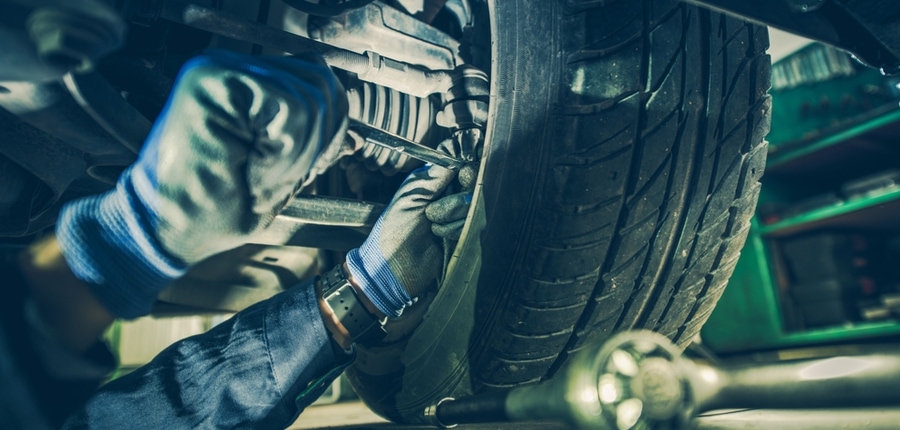
The well-nigh mutual failure is looseness; wear in the ball and socket end of the tie rod. A pocket-sized amount of wear is usually non noticeable when driving, but will prove up equally tire wear.
Any play straight affects the toe angles of the wheels which is the primary wear angle of the wheel alignment. A larger amount of looseness can be felt every bit loose steering. Where the vehicle wanders, the steering has to be corrected often to go along the vehicle driving in a straight line and the steering wheel has to be turned significantly before the vehicle responds.
This is like shooting fish in a barrel to diagnose with a vehicle up on a lift as the front wheels are "shaken down" in a standard suspension check. On well-nigh modern vehicles, there should be no noticeable play in the bike, side-to-side or up and downwardly. Various other things can cause play but tie rod ends are the most common.
Physical impairment is also possible. A curb hitting, for instance, transmits a great deal of sudden forcefulness into the tie rod end and they can bend. In some cases, the tapered pivot can shear off; at which point the vehicle is undrivable.
In some areas where the roads are salted and sometimes, for no obvious reason, the tie rod adjusting mechanism can freeze up. If alignment adjustments demand to be made at a tie rod but the part cannot be freed up to allow adjustments, it's commonly recommended that the function exist replaced – often both the inner and outer joint together.
Outer necktie rod ends have a small kick that protects the joint from road grime and weather condition. Inner tie rod ends on a steering rack have a bellows that protects the joint.
In either instance, if the boot or bellows is torn, that can let the grease to escape or dry out and the grit and h2o to enter which can atomic number 82 to rapid failure. Information technology was normal in the by for tie rod ends to have a grease fitting that allowed them to be regularly serviced, but this is increasingly rare. Name-brand aftermarket parts oftentimes provide a grease fitting; even where the OE part beingness replaced lacked one.
Source: https://spendonauto.com/tie-rod-replacement-cost/
0 Response to "How To Repair Tie Rod"
Post a Comment